
Tarrant County's seat, now past one million residents
Foundation Repair in Fort Worth, TX
Slab and pier-and-beam repair across a city whose homes span many eras and whose soils swing with the seasons.
- Free on-site foundation evaluations
- Floor elevation measurements included
- Written quote before work starts
Reading a Foundation Through Fort Worth's Seasons
Foundation Repair in Fort Worth means working across a huge and varied city. Fort Worth covers about 347 square miles of land and reached an estimated 1,028,117 residents in 2025, up 11.9% from 2020. A house near the historic core and a house in a brand-new subdivision at the city's edge can have very different foundations, lots and drainage, so every visit starts with figuring out exactly what kind of structure we are standing on.
Wet months and dry months
Soil moisture under a house follows the calendar. At Fort Worth Meacham International Airport, the 1991 to 2020 climate normals show about 4 inches of rain in each of May and June and 4.46 inches in October, but only about 2.2 inches in each of July and August, when average daily highs sit near 96 degrees. Clay soil tends to swell in the wet stretches and shrink in the dry ones, so cracks can open up in late summer and partly close again in fall. We note the season in every report and suggest a second set of readings when a first measurement is borderline.
Raised floors in older neighborhoods
Fort Worth began in 1849 as an army outpost on a bluff above the Trinity River, and its older neighborhoods can include houses built on pier-and-beam foundations. In a house like that, uneven floors can trace back to settled interior piers, shims that have compressed or slipped, or moisture in the crawl space. That work is done from underneath the house, and it is quite different from lifting a slab.
Newer slabs at the edges
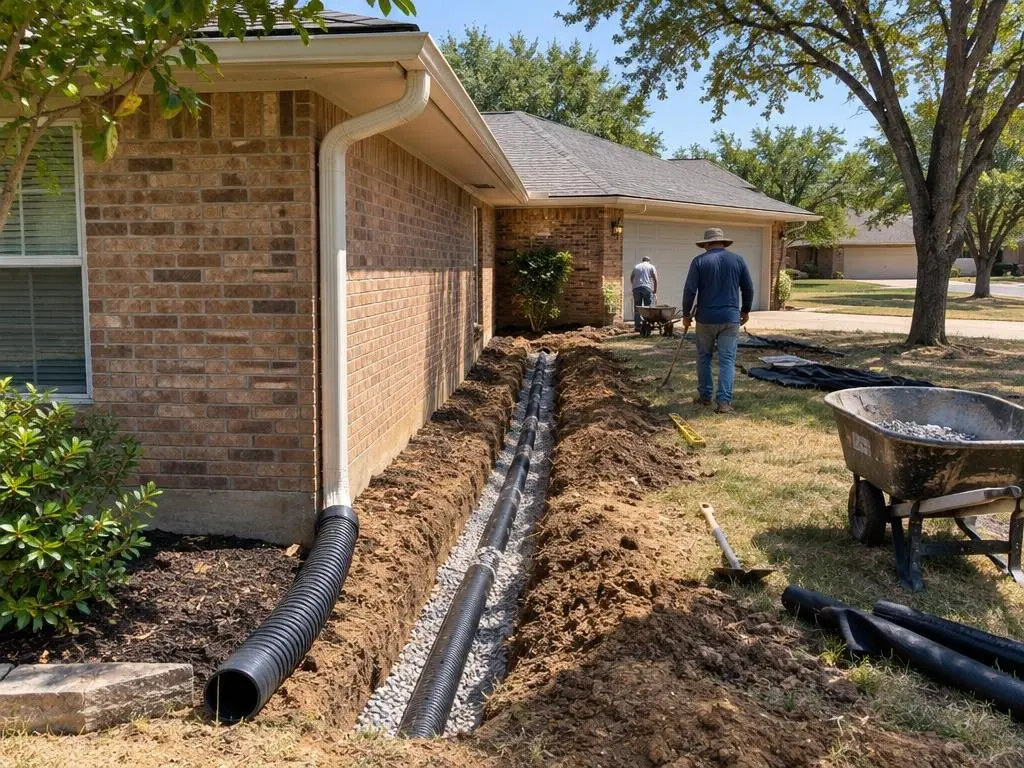
The city has added more than 100,000 residents since 2020, and growth like that comes with new subdivisions and young concrete. In newer subdivisions, the shared drainage swales between lots are designed to carry water to the street. Fences, raised beds, sheds or patio extensions that block those swales can leave water standing beside a slab. Restoring the intended flow, or adding a French drain, is sometimes the first and simplest step.
Permits in Fort Worth
Residential permits in Fort Worth go through the city's Development Services department. Foundation repair rules differ from city to city across the Metroplex, so ask Development Services what your specific repair requires before work begins. When an engineer's plan is required or simply advisable, we work from that plan.
Services across Fort Worth
- Slab foundation repair with piers
- Pier-and-beam leveling and crawl space repair
- Foundation drainage and French drains
- Root barrier installation near mature trees
- Foundation crack repair
Keeping moisture steady after a repair
Once a repair is finished, the soil around the slab still reacts to the weather. A few habits help: keep gutters clear, extend downspouts several feet from the house, keep beds sloping away from the foundation, and avoid letting one side of the yard stay soaked while another bakes. These steps are worth taking whether or not your house ever needs piers.
Fort Worth Context
- Founded on the Trinity. Fort Worth was established on June 6, 1849 as an army camp near the Trinity River. The post flooded in its first year and was moved to the top of the bluff, where the county courthouse stands today.
- A wet spring, a dry summer. Meacham Airport's 1991 to 2020 normals list 4.02 inches of rain in May and in June and 4.46 inches in October, versus 2.18 inches in July and 2.23 inches in August, with a July mean daily high of 95.7 degrees.
- Rapid growth. Fort Worth grew from 741,206 residents in 2010 to 918,915 in 2020, and the Census estimates 1,028,117 for 2025.
- Ownership and values. Census figures for 2020 to 2024 show 57.0% of Fort Worth housing units occupied by their owners, with a median owned-home value of $303,000.
Fort Worth Questions
Is there a good time of year to have my Fort Worth foundation checked?
Any time works for a first evaluation. Because readings can shift between the dry late summer and the wetter fall, we record the season and, when a result is borderline, suggest re-measuring a few months later before committing to a major repair.
My cracks open in summer and close in winter. Is that normal?
Some seasonal movement is common on clay soil, but cracks that keep getting larger from one year to the next deserve attention. Elevation readings taken at different times of year show whether the house is cycling or steadily moving in one direction.
Do you work on pier-and-beam houses in Fort Worth's older neighborhoods?
Yes. We inspect the crawl space, measure floor elevations, and recommend re-shimming, added piers, framing repairs or moisture fixes based on what we find. Each recommendation is itemized in a written quote.
Does Fort Worth require a permit to fix a foundation?
Ask the city's Development Services department, since requirements depend on the type and scope of work and can change. If an engineer's plan is part of the process, we work alongside whichever engineer you hire and follow that design.
Foundation Repair Near Fort Worth
- Foundation Repair in North Richland Hills, TX
- Foundation Repair in Richland Hills, TX
- Foundation Repair in Haltom City, TX
- Foundation Repair in Watauga, TX
- Foundation Repair in Keller, TX
- Foundation Repair in Hurst, TX
- Foundation Repair in Euless, TX
- Foundation Repair in Bedford, TX
- Foundation Repair in Colleyville, TX
- Foundation Repair in Grapevine, TX
- Foundation Repair in Southlake, TX
- Foundation Repair in Saginaw, TX
- Foundation Repair in Arlington, TX
- Foundation Repair in Irving, TX
- Foundation Repair in Grand Prairie, TX
- Foundation Repair in Mansfield, TX
- Foundation Repair in Flower Mound, TX
- Foundation Repair in Coppell, TX
- Foundation Repair in Haslet, TX
- Foundation Repair in Roanoke, TX
- Foundation Repair in Trophy Club, TX
- Foundation Repair in Westlake, TX
- Foundation Repair in Lake Worth, TX
- Foundation Repair in Azle, TX
- Foundation Repair in Benbrook, TX
- Foundation Repair in White Settlement, TX
- Foundation Repair in River Oaks, TX
- Foundation Repair in Burleson, TX
- Foundation Repair in Kennedale, TX